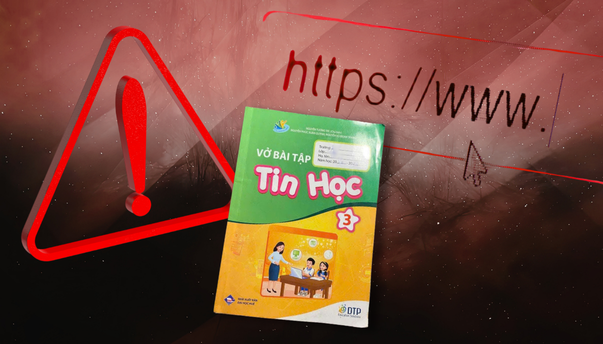
Recently, many parents have reported that exercises in a Grade 3 “Informatics Workbook” require students to access a provided link for practice, but the link redirects to websites with adult content, inappropriate for children. Bkav cybersecurity experts stated that the domain of the link printed in the material was originally registered in 2018 and has gone through multiple changes over time.
In April 2024, the domain was changed to gambling-related content. By June 2025, it expired and was released from the registration system, then re-registered by another entity through a new registrar, and switched to using Cloudflare’s DNS infrastructure. This is essentially a case of domain re-registration after expiration. According to Bkav experts, at the time the educational material was compiled, the link may have been valid and served its intended educational purpose. However, once the domain expired, a different party could re-register it and freely change its content beyond the control of the original publisher.
The vulnerability lies in the process of editing and publishing materials that include internet links without mechanisms for monitoring, periodic review, or lifecycle management of these links after publication. As a result, the content of such links may change without timely detection by the responsible parties.
Bkav cybersecurity experts also noted that, at the time of inspection, there were no signs of malware distribution or fraud associated with this domain, but potential information security risks remain.
The educational material in question belongs to the “Cùng khám phá” (Explore Together) series, published by Hue University Publishing House and distributed by DTP Education Solutions (under Dai Truong Phat Group). In a market with a wide variety of books and reference materials, content quality control is becoming increasingly complex, especially for supplementary materials outside the official curriculum. Bkav experts recommend:
For publishers and distributors:
- Limit the direct use of fixed internet links in printed materials.
- Implement intermediary systems to control and update digital content.
- Conduct periodic reviews of online resources referenced in educational materials.
For parents and schools:
- Carefully check links before allowing students to access them.
- Supervise and accompany children when using the Internet, especially at the primary school level.
- Prioritize content sources that are verified and age-appropriate.
- Equip children’s learning devices with control tools, such as Bkav Safe Kids, to filter content, monitor access, and limit usage time.
Bkav